2930 Carol Rd., Suite A, York, PA, 17402


 Call Us Now
 Email Us Now

💡 Key Takeaways
- Criminal convictions commonly drive deportation outcomes: Aggravated felonies and crimes of moral turpitude are a frequent basis for removal compared to other grounds.
- Status, violations, and federal priorities determine risk: Entry without inspection, visa overstays, unauthorized work, and shifting enforcement policies all affect the likelihood of removal.
- Eligible immigrants may obtain relief from removal: Options like asylum, cancellation of removal, Temporary Protected Status, or protection under CAT can allow some to remain in the U.S.
Until they obtain citizenship, noncitizens living in the U.S. are at risk of being deported by the U.S. government. Common deportation reasons include being undocumented or violating the terms of a visa. But what is the most common reason for deportation? Criminal convictions—particularly for aggravated felonies and crimes of moral turpitude—have historically been a steady and very common reason for deportation.
Facing deportation proceedings can be incredibly stressful. If you are concerned about deportation, contact the Law Office of Rosina C. Stambaugh. We understand that immigration proceedings threaten to uproot lives, and we are dedicated to helping noncitizens navigate the daunting U.S. immigration system. We are here to help you understand your options and fight to protect what matters to you.


What Is Deportation?
Removal proceedings are the method by which the government requires a noncitizen to leave the country. Removal includes processes formerly known as deportation and exclusion proceedings. Yet, in everyday speech, the words deportation and removal are often used interchangeably.
What Are the Possible Reasons for Deportation?
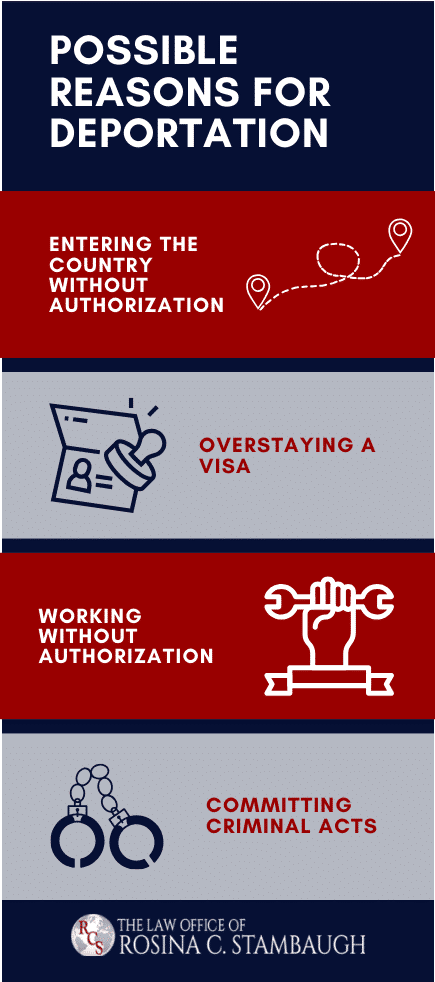
In simple terms, a person can be deported if they are not authorized to be in the country or violate the terms of their authorization. So, what are the reasons for deportation? Common reasons include the following:
- Entering the country without authorization (EWI),
- Overstaying a visa,
- Working without authorization, or
- Committing criminal acts.
Note that noncitizens with a “credible fear” that they will be persecuted in their home country may be entitled to request asylum and remain in the U.S. while their case is pending.
Entry Without Inspection (EWI)
Many undocumented individuals entered the country without passing through Customs and Border Protection (CBP). Noncitizens may be deported for entering the U.S. without inspection or EWI.
Visa Overstay
Many undocumented individuals had a valid immigration status at one time but remained in the U.S. after that status ended. Noncitizens who overstay their visas may be deported as well.
Unauthorized Work
Many noncitizens are deported not only because they are undocumented but because they worked while undocumented or unauthorized to work here. Notably, Immigration and Customs Enforcement (ICE) has completed several raids on workplaces that hire many undocumented workers. Indeed, any noncitizen without work authorization may be deported for working in the U.S.
Crime
Many noncitizens are also deported for criminal acts. Deportable crimes range from relatively minor nonviolent crimes to serious violent crimes. Knowing whether a crime may lead to deportation typically requires consultation with a lawyer familiar with federal immigration law and state criminal law.
What Raises the Risk a Noncitizen Will Be Deported?
A noncitizen’s risk of deportation depends on a few factors.
- If the noncitizen has status, that status will impact their risk of deportation.
- If the noncitizen violates the terms of their status, that violation will increase their risk of deportation.
- If the noncitizen lacks a valid immigration status—whether or not they qualify for immigration relief—their risk increases.
- Current governmental deportation priorities.
Frequently, many of these factors are interrelated and cross over one another.
Noncitizen’s Legal Status
The government is more likely to deport a noncitizen if it determines it is worth the time and resources. A noncitizen with a temporary visa that authorizes a stay of only a few weeks or months may avoid being targeted as long as they depart the country.
On the flip side, a temporary worker with a visa lasting several years may have a higher likelihood of being targeted for deportation. A noncitizen with a green card who has lived in the U.S. for years generally cannot be deported unless they are convicted of certain criminal offenses.
Type of Violation
Minor violations of immigration law, like a slight delay in status renewal, are less likely to lead to deportation than serious violations. Criminal activity is typically the most serious violation and most likely to lead to deportation.
Immigration Relief
Some noncitizens can avoid deportation if they qualify for immigration relief. For example, a noncitizen may be able to obtain legal status if they have a relative who can petition for a green card for them. Often, many individuals without status are eligible for Cancellation of Removal for Non-permanent residents (EOIR 42b). This is relief available for individuals who do not have a green card and can demonstrate that they have been in the U.S. for 10 years or more, have a U.S. Citizen or lawful permanent resident spouse, parent of child under 21 who would suffer exceptional and extremely unusual hardship if the noncitizen is removed. Others may be eligible for relief through a program like Temporary Protected Status (TPS) or the Convention Against Torture (CAT).
Deportation Priorities
Through the president, the government sets ICE’s deportation priorities, affecting a noncitizen’s likelihood of being deported. For example, President Obama established the Deferred Action for Childhood Arrivals (DACA) program, declaring that those who qualify are not a deportation priority.
In contrast, under Presidents Obama and Trump, individuals with no criminal history were deported at an equal or greater rate than those with criminal histories. When President Biden took office, the executive branch shifted focus more to those with a criminal history.
What Is the Most Common Reason for Deportation?
As mentioned, the single most common reason for deportation is criminal activity. This may be because criminally convicted noncitizens have fewer options for immigration relief. It is also related to the priorities set by the president, especially policies asserting that anyone who violates U.S. criminal law is less desirable and should not be allowed to stay in the country.
What Can You Do About Deportation?
If you or someone you love is risking deportation, reach out to the Law Office of Rosina C. Stambaugh. We can help you understand your options, prepare an effective case strategy, and fight for your rights in court.